
Gustav Vasa couldn’t ski?
The 16th century King, Gustav Vasa, considered founder of modern Sweden, may not have skied the famous 90k-race after all ...
-
 The 102nd edition of Vasaloppet took place on Sunday, March 1, 2026, featuring over 15,000 skiers in a challenging, snowy 90-kilometer race from Sälen to Mora, Sweden.
 -
-
The 102nd edition of Vasaloppet took place on Sunday, March 1, 2026, featuring over 15,000 skiers in a challenging, snowy 90-kilometer race from Sälen to Mora, Sweden. Oskar Kardin (Sweden) won the men's race in 4:14:45.5, while Emilie Fleten (Norway) secured the women's title with a time of 4:24:26.3.
-
 Oskar Kardin (Sweden) won the men's race in 4:14:45.5, while Emilie Fleten (Norway) secured the women's title with a time of 4:24:26.3. Both center and flanked by the “Kranskulla” Maja Stefansson, far left, and “Kransmas” William Mathisen, far right.
 -
-
One of Sweden's most famous kings, Gustav Vasa is perhaps mostly known to the after world for skiing across the forests through Dalarna in 1520 while being hunted by Danish soldiers.
-
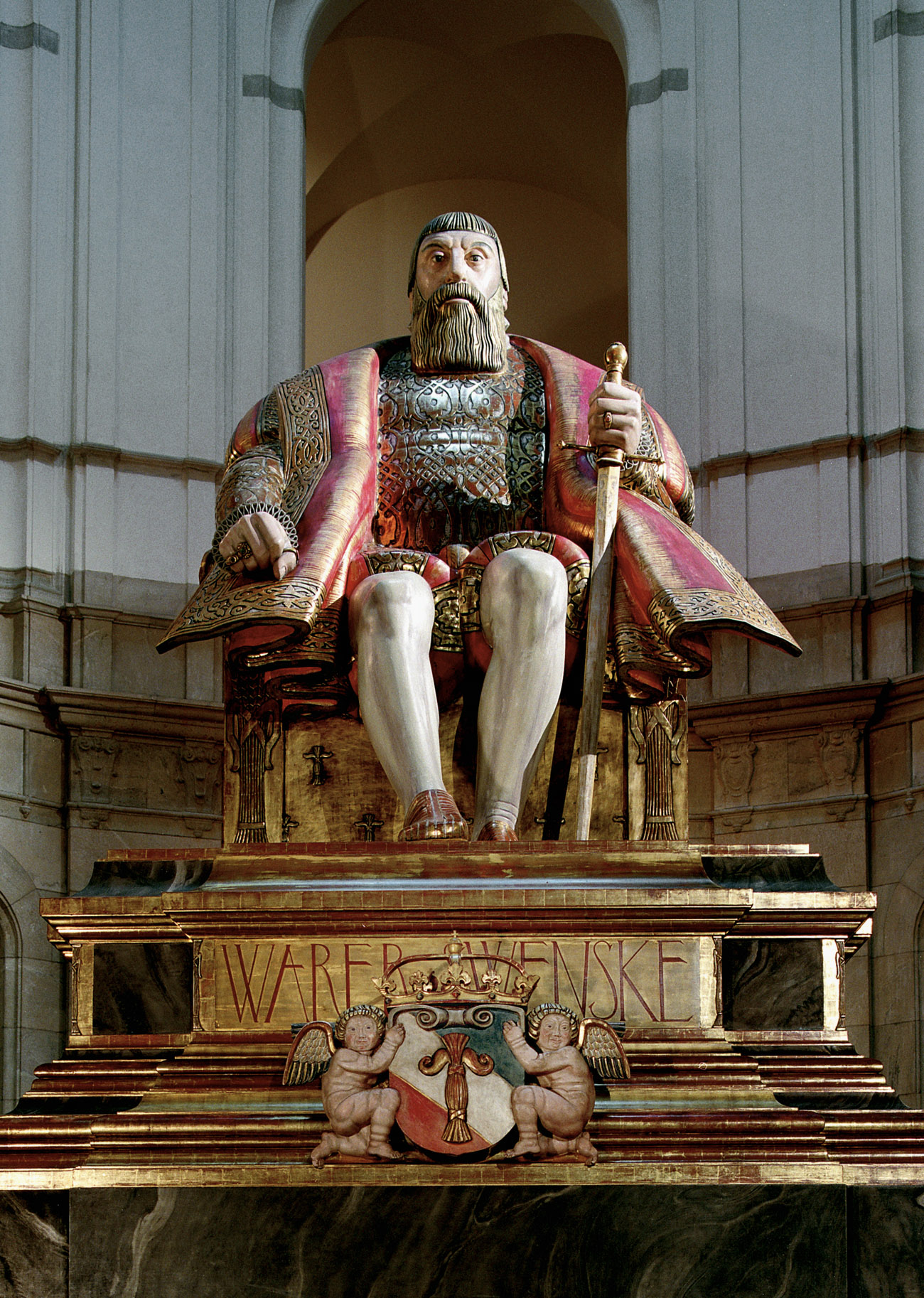 Gustav Vasa (1496-1560), in Nordiska Museet, Stockholm. New research says Vasa didn’t know how to use skis, which of course upsets the history of the Vasaloppet – the annual long distance cross-country ski race held in northwestern Dalarna, Sweden.
 -
But according to a theory by a local researcher, Gubb Tage Bevring in a district of Dalarna, Gustav Vasa did not even know of skis, much less how to use them. Bevring, a reputed genealogist and researcher in the area, has found correspondence that clearly indicates the King was not aware of the local practice of using "planks" to cover distances in the snow. The researcher thinks that Vasa instead used a horse and perhaps snow shoes.
-
 Gustav Vasa, considered the founder of modern Sweden, illustrated the Swedish 1000-kronor bank note until 2014 when UN Secretary General Dag Hammarskjöld's image was used.
 -
Gustav Vasa (1496-1560), the first monarch of the House of Vasa, and one of the most (if not the most) important people in Swedish history. Vasa became the first truly autocratic native Swedish sovereign and was a skilled propagandist and bureaucrat who laid the foundation for a more efficient centralized government. During his reign Protestantism was introduced in the country.
-
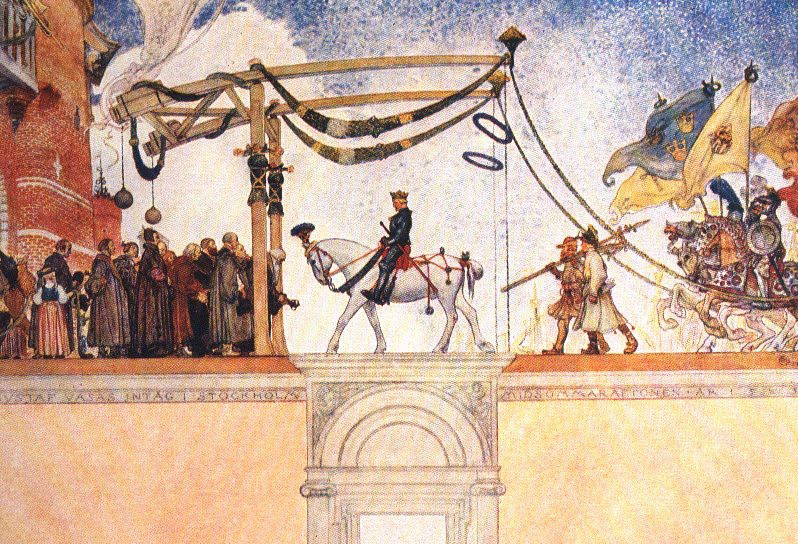 Carl Larsson's painting of Gustav Vasa's entry to Stockholm 1523 was painted on the wall at the entrance to Nationalmuseum - National Museum of Fine Arts in Stockholm.
 -
The history of how Gustav Vasa escaped the Danes by skiing has today resulted in the world famous Vasaloppet, held the first Sunday of March each year. http://www.vasaloppet.se/
-
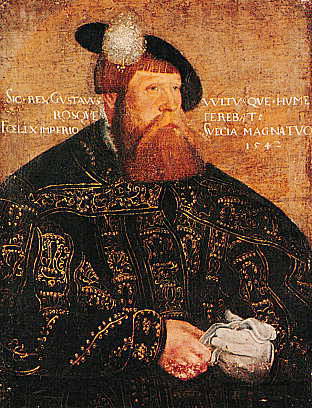 Gustav Vasa (1496-1560).
 -
Today, there's also the Vasaloppet in the USA, in Mora, Minn. https://www.vasaloppet.us
A Vasaloppet in Japan has been held in Asahikawa, Hokkaidō, In China in Changchun and more recently also in Canada, in Jonquière, Québec. -
 Gustav Vasa, not a skier after all..?
 -
Gustav Vasa, with or without skis has always been a big part of Swedish history. Beloved national painter Carl Larsson painted his entry to Stockholm 1523, in 1908. The painting is painted on the wall at the entrance to Nationalmuseum -National Museum of Fine Arts in Stockholm.
-
Vasa is omnipresent in Sweden. Gustav Vasa, considered the founder of modern Sweden, used to illustrate the 1000-kronor bill, the Vasa museum (not the King, however, the ship that sank) is among Stockholm's biggest attractions, http://www.vasamuseet.se/ and there used to be a Gustav Vasa Hotel, near Odenplan in Stockholm, at Västmannagatan 61 in the so-called Vasastaden district of the city.
-
-