
U.S. National Kubb Championship
The first written mention of kubb dates to 1931, in a book by an ethnologist visiting the Swedish island of Fårö in the province of Gotland. It is also there that the first games of kubb were likely played by Vikings. The goal is to knock over all of the opposing team's baseline kubbs, and then knock over the king to win. Hitting the king before all kubbs are cleared results in an immediate loss.
-
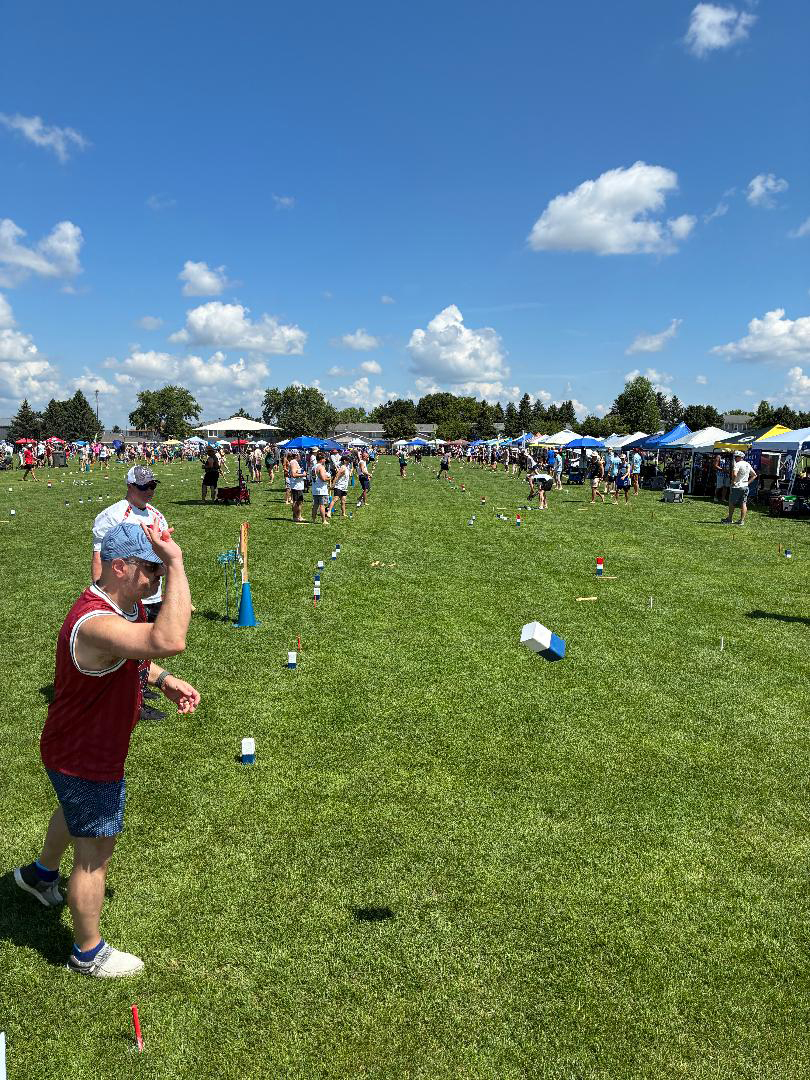 The word kubb comes from "vedkubbar," which means wooden block in the Swedish dialect of Gotland.
-
-
With just wooden blocks and batons used in kubb (pronounced "koob"), the 19th U.S. National Kubb Championship was held July 11-12 in Eau Claire, Wisconsin, the "Kubb Capital of North America.” More than 144 teams and 502 players coming from more than 25 states made up the 3-person team tournament championship run. They came from as far east as the Atlantic Coast and as far west as the Pacific Coast, from northern Minnesota to central Florida, and even Canada and Belgium.
Eric Anderson is the founder and director of the U.S. National Kubb Championship held in Eau Claire every July. “Competition was fierce (can kubb be fierce?) and the winners of the 144 team round-robin schedule were Kubb Reapers from Eau Claire and Hartford, Wisconsin.
“This competition is very family friendly. All ages play in the U.S. National Kubb Championship. Families play. Multi-generational teams. We started the U.S. National Kubb Championship in 2007. It had 15 teams and 34 players. Eau Claire passed a resolution that we are officially the Kubb Capital of North America!” -
 Eric Anderson, founder and director of the U.S. National Kubb Championship held in Eau Claire every July.
-
-
Carefully knock over the king
The word kubb comes from "vedkubbar," which means wooden block in the Swedish dialect of Gotland, where the Vikings may have played it, thus it is sometimes marketed as Viking Chess. There is evidence that skittle games similar to kubb were played in ancient Egypt and in Greece — suggesting the game migrated north, rather than the other way around.
Kubb is a very simple game to understand and play and it is certainly a game of great skill and strategy. The simple rules are these:
First, set up a 5m x 8m pitch on flat grass, sand (or snow!) and decide who will go first. Team A throws the 6 batons from behind their baseline at the opposition's 5 kubbs, which are at the opposite baseline of the pitch. The king piece is in the center of the pitch. Batons must be thrown underhand and straight on (not spun). After all the batons have been thrown, the opposing team (Team B) gathers up any kubbs that have been knocked down. Team B throws them back to Team A's side. If they are thrown back into play they are called field kubbs. Any kubbs which land outside the field or not passing the center line can be re-thrown by team B. If any kubb lands out of bounds, Team A can place it anywhere on the pitch that is at least one baton's length from the king kubb. The game continues with play alternating between the two teams until one team's entire baseline kubbs have been knocked down. The winner is the team who knocks down all their opponent's kubbs and then knocks over the king. But if a team knocks down the king prior to knocking down all of the kubbs that team will immediately lose the game. -
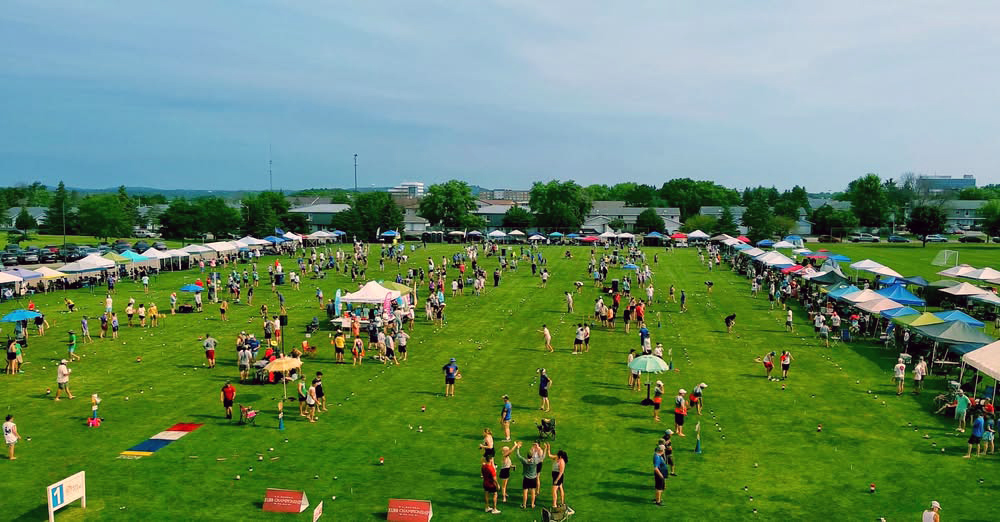 The U.S. National Kubb Championship in Eau Claire has grown from 15 teams in 2007 to a capped maximum of 144 teams, drawing players from dozens of states and international destinations.
-
Kubb unites people
The world championship's slogan is "Kubb unites people and creates peace on earth," which perfectly captures the spirit of the game.
This year marked the 7th European Kubb Championship, played in beautiful Linz, Austria where Switzerland's 6x6 and 3x3 teams defeated Germany. Last year's championship was in Switzerland, Belgium, Germany, Sweden, Czech Republic and France, in which 12 participating nations over six unforgettable weekends united people in peace.
“It is not uncommon for Americans to go and play in the World Championship, too. I went in 2011 and 2014,” Eric explained. “The World Championship, like the U.S. Championship, is open to anyone who wants to play. 2027 will be our 20th championship. We currently have a rule that at least half a team has to be American. But next year, we are opening it up to any team in the world, so teams from anywhere can come and play.”
Indeed a great way to unite people and create peace on earth. -
Nils R. Caspersson
-
-