
Sweden's ambassador: Truly transatlantic
On Sweden, the U.S. and our present relationship along with Swedish activities to celebrate the United States Semiquincentennial, the 250th anniversary of the United States Declaration of Independence. We recently caught up with Urban Ahlin, the Ambassador of Sweden to the United States.
-
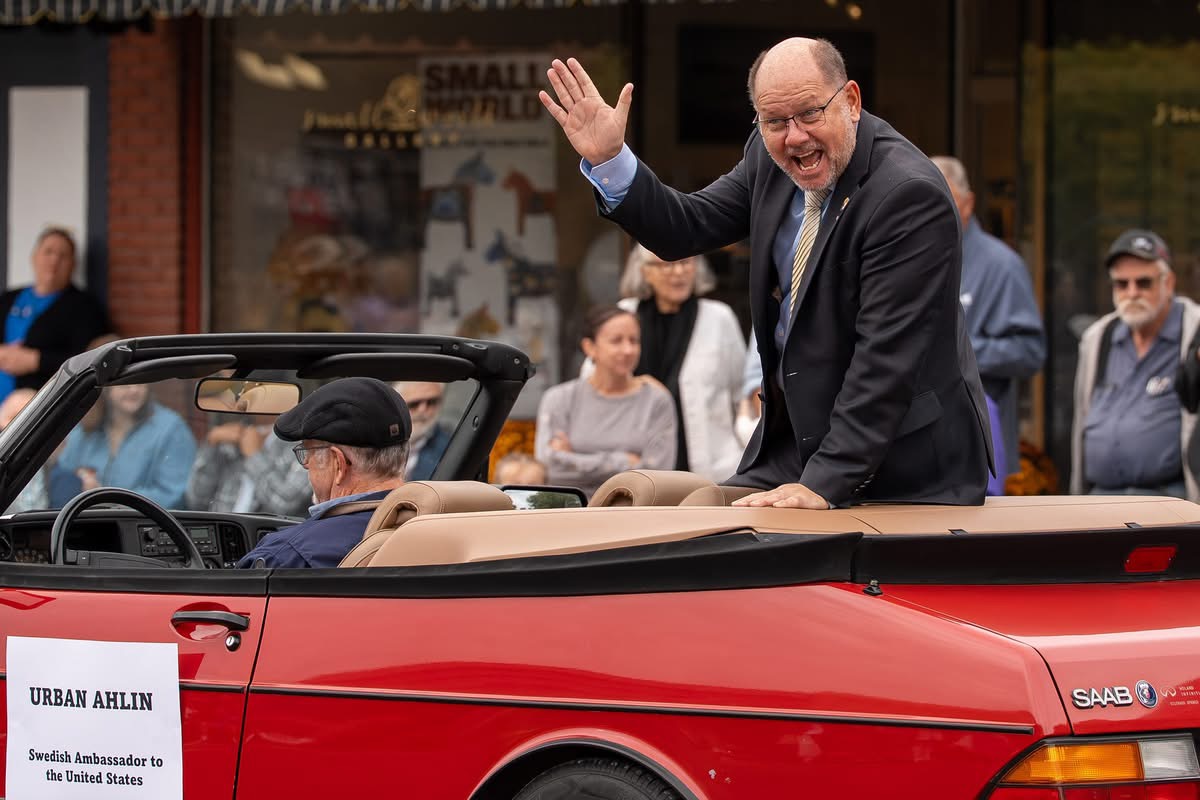 Ambassador Ahlin has visited many of our Swedish American places, venues and locations. Here greeting the crowd at Svensk Hyllningsfest in Lindsborg, Kansas 2025.
 -
-
His Excellency Urban Ahlin, the Ambassador of Sweden to the United States, seems at ease and eager to talk as we catch up with him during a brief visit to Sweden earlier this spring. Representing a small nation in what’s possibly the world’s largest powerhouse can likely be frustrating at times but the message we’re getting from the ambassador is far from frustrated.
“I like to be here, love America and enjoy working for Sweden. I am a true transatlantic, have been for a long time.” After many years as a Social Democrat, Ahlin was in 2023 asked to take the post in Washington, DC by the then conservative Swedish government.
“It was a great joy to be asked by “the other side” and I gratefully accepted,” he says. Ahlin later in our conversation reminisces on a telling comment by Sweden’s present Minister of Defense Pål Johnsson, who during a speech in DC said: “Some in Sweden are saying that we [the government] purposefully sent you away from Swedish politics, Urban, when in reality, those of us who know you well are aware that what we did was send you home.”
The Ahlin family has a long history in the United States. “My wife used to work at the local newspaper, Mariestadstidningen. It belonged to a larger publishing group which offered a vacation home in Florida to its staff,” Ahlin tells us. “We spent time there when we could, and once we became parents we started visiting regularly. The first time, in the early 1990s, the exchange rate was extremely favorable for us. It was an amazing opportunity, but as a teacher with a working-class background, I did not have the money for a second home in the U.S. Quite a bit later, I had been saving up to buy a new car in Sweden when the housing collapse hit. The subprime mortgage crisis in 2008 became quite pronounced in Florida, and with house prices going down I decided, instead of getting a new car, why not buy a small house in Florida?”
Ahlin was born in 1964 in Mariestad, Skaraborg now part of Västra Götaland County, between lakes Vättern and Vänern. The area is known as the cradle of Sweden, filled with plateau mountains, fertile plains and rich cultural history going back to medieval times. It lies about half-way between Göteborg (2.5 hours by car) to the west and Stockholm (3.5 hours) to the east. Maybe this is why Ahlin likes his second home so much, “I enjoy the laid back and relaxed attitude in Florida. Miami is a metropolis with lots of traffic and the pace is more hectic, but near the west coast and in central Florida you find a more relaxed lifestyle.”
After studies at Karlstad University, Ahlin taught math and science at a school in Mariestad until he was elected to the Swedish Parliament in 1994. He served as Member of the Riksdag (MP) for the Västra Götaland County East constituency starting in 1994 and became chairman of the Committee on Foreign Affairs in the Swedish Parliament 2002-2006. From 2006 to 2014, he was deputy chairman of the committee and was the foreign policy spokesperson for the Social Democrats. He became Speaker of the Riksdag (Parliament of Sweden) in September 2014 until September 2018. At that point he had to relinquish his party ties since the Speaker in Sweden must be politically neutral. “It was a lot of fun to work with all eight parties in Sweden, find solutions and work on how to make the Riksdag work better, when to announce a plenary sitting, etc. My time as Speaker may have been an excellent stepping stone to diplomacy.”
Ahlin went on to become the Ambassador of Sweden to Canada from 2019 to 2023. He presented his credentials to President Joe Biden in September 2023 and brought a tremendous amount of both knowledge and experience with him as he became the Ambassador of Sweden to the United States. -
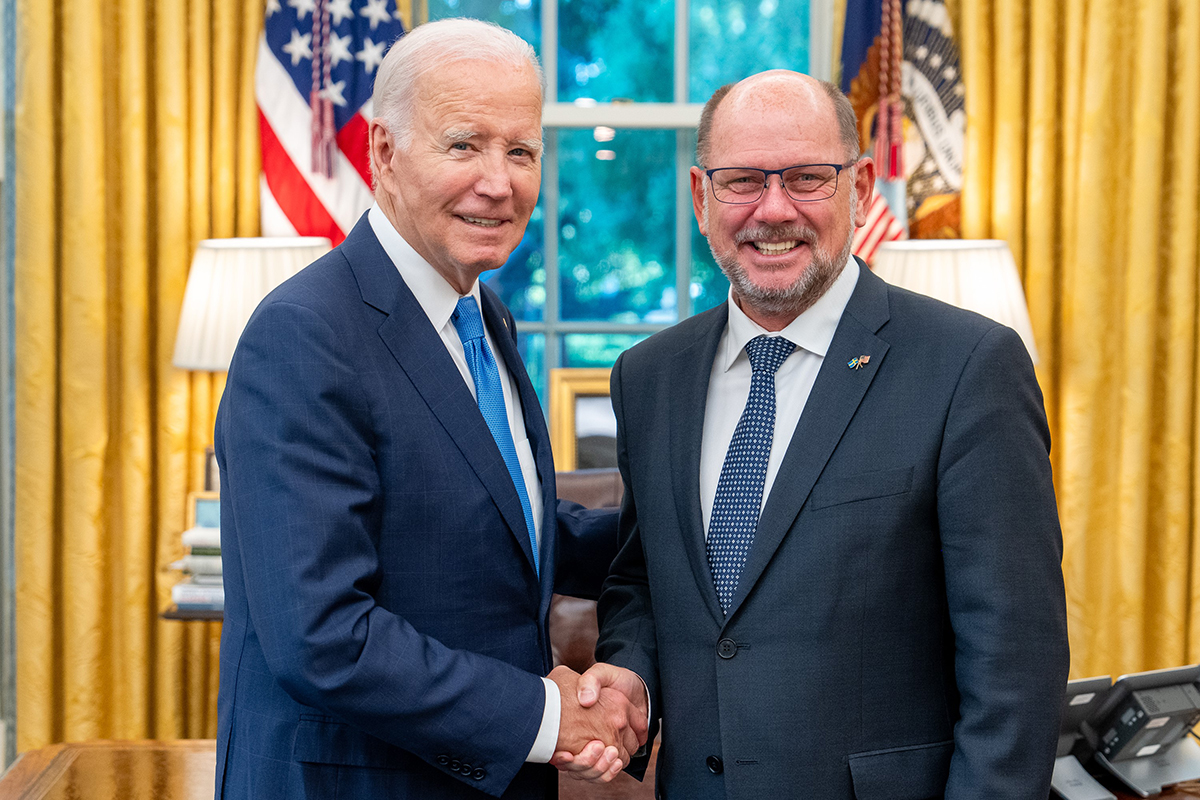 Ambassador Urban Ahlin presented his credentials to President Joe Biden in September 2023. Photo The White House.
 -
-
Q. What is more fun, diplomacy or politics?
A. Hands down, politics. It’s fun to be an ambassador but nothing beats politics. To be elected by the voters, to be an elected official … if you enjoy being there at the forefront, among people and in front of people, there’s simply nothing better than to be an elected official. I am proud to have been reelected so many times with increasing support every time. Skaraborg, traditionally conservative, changed during my tenure. -
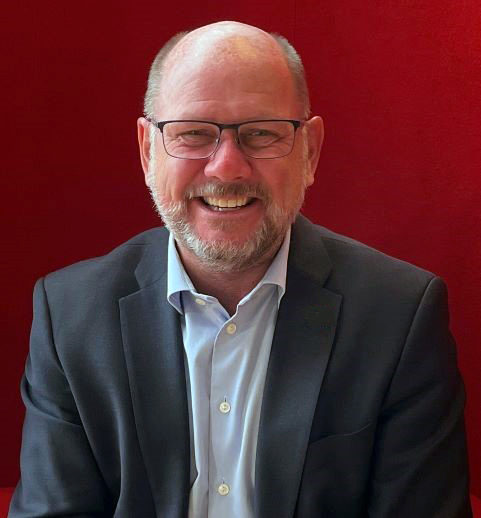 Urban Ahlin, the Ambassador of Sweden to the United States.
 -
The move to diplomacy
“When asked to serve in Canada I was surprised I never received guidelines or instructions on the goal of my job. So the first thing I did in Ottawa was interview local Swedish industry representatives asking what they felt I could and should work with. What would support their efforts? We ended up focusing on a select few areas: defense industry, mining, forestry, paper and pulp and critical minerals. The cooperation between Canada and all the Nordic countries has indeed developed in recent years - not least evidenced by Canada Prime Minister Mark Carney’s visit to the Oslo summit in March this year.
“When asked to take on the same job in the U.S., the conservative government was very clear in their guidelines. Our focus with the U.S. should be our national Swedish interests rather than being politically activist. They wanted us to get away from the traditionally somewhat square activist foreign policy and put the emphasis on “Sweden First.” Somehow it felt easier to go to the U.S. since the instructions were so clear.” -
Q. What was your main goal when you arrived in Washington, DC?
A. The first year was easy because I knew the administration from my earlier work as a politician, had met Biden on several occasions in a variety of political work groups and became heavily involved in the process of paving the way for Sweden’s NATO membership. It became a comfortable time since I knew what was expected from me by my own government and had access to a lot of people in the administration through my earlier career as a politician.
Then we had the election, Harris lost and a completely new administration took office. First off, with the new policies in Washington, I had to reboot our own work to make sure we were all on the same page about working to achieve what’s best for Sweden. Regardless of administration we have to figure out what it is we want for Sweden, what the U.S. would like and what we can offer. Finding common ground is a must.
In my discussions with the Trump administration, I have been clear: “I fully understand you have an America First policy but you have to respect I’m here with a Sweden First policy and to promote Swedish interests. Let’s try to find areas where we can both gain from cooperation, to mutually benefit our nations.”
This has so far worked quite well. The Defense Cooperation Agreement (DCA) — in force as of August 15, 2024 — establishes a framework for enhanced military cooperation, allowing U.S. forces access to Swedish military bases, pre-positioning of equipment at 17 bases, and legal status for personnel. We have also entered a bilateral agreement with the New York National Guard, all in the interest of getting to know each other, learn from each other and be prepared … in case, God forbid, a war situation develops where we need to cooperate.
Telecom and technology are two other areas where we’ve both strengthened our in-house competence and opened new consulate generals in both San Francisco and Houston. Sweden is also part of the Pax Silica initiative, having formally signed the declaration on March 17, 2026, becoming the first European Union country to do so.
I received a good start by getting clear instructions from the government, and my staff and I have focused on the things that are important to us and can contribute to the U.S. — all of which has created a situation where the present administration feels Sweden is of interest and can contribute. We have a good cooperation although it’s not always easy. I remind my colleagues at the embassy how our assignment is to create the best possible cooperation with the Trump administration, and as long as said cooperation is good for Sweden, that’s what we should do. -
Q. You are very direct and don’t mince words. Is it a diplomatic skill to be so candid?
A. Both administrations I’ve worked with have appreciated our conversations. It makes things so much easier if you know what your interests are and make your positions clear. In my experience, especially Americans appreciate a direct conversation. You have one chance to make an impression when you meet a decision maker. You must bring something of interest to the table. You must be relevant, understand the American view, see problems and solutions, always be creative with solutions. Sweden and the U.S. are bound together in so many ways (Sweden, a country with a population of 10.5 million, just passed Australia and is now the ninth largest investor in the United States)! We have more PhD students per capita in the U.S. than any other country and over 400,000 Americans in USA are directly employed by Swedish industry. We — Sweden and Europe — are dependent on the U.S., and America is just as dependent on Europe, in spite of what is sometimes said. It’s my job to make sure Sweden is as interesting as possible to the powers in Washington, and so far, knock on wood, we’ve successfully met expectations. -
Q. How are you perceived, and how is Sweden perceived by the politicians you meet every day?
A. There are two separate groups. The overwhelming majority has a positive view of Sweden, they like Sweden, know it’s a welfare state, a democracy with a long tradition of cooperation with America. They know we have a strong defense and a strong defense industry, and we are known as trusted partners, as decent people and a stable country many hold in high regard.
What has changed over these last years are critical views on Sweden’s refugee politics, assimilation and criminality. With those views as a starting point, convincing someone about the benefits of working together becomes an uphill battle. Keeping in mind there must always be something of interest to them is helpful. For example, when meeting with Senator Rand Paul, a conservative and leading advocate for liberty, we talked about the Swedish retirement system. We discussed the Swedish “socialist” pension system which ties benefits to contributions, increases retirement age with prolonged life expectancy, and supplemental benefits are reevaluated annually based on demographic and economic conditions, all while balancing the overall budget. Our meeting resulted in the senator writing an Op-Ed titled “Why America Should Be More Like Sweden (It's Not What You Think!)”
Urban Ahlin, Sweden’s ambassador to the U.S., is not as Swedish as you think, either. Transatlantic for sure. -
Ulf Barslund Martensson
-
Link to Swedish activities to observe the 250th anniversary of the United States Declaration of Independence: Sweden celebrates America 250
-
-