
Pioneer travelers of the Erie Canal
The canal, opening in October 1825 became the route of choice for the first group of Norwegians to immigrate to the United States, the so-called sloopers—quite possibly the first group of immigrants to travel the completed Erie Canal.
-
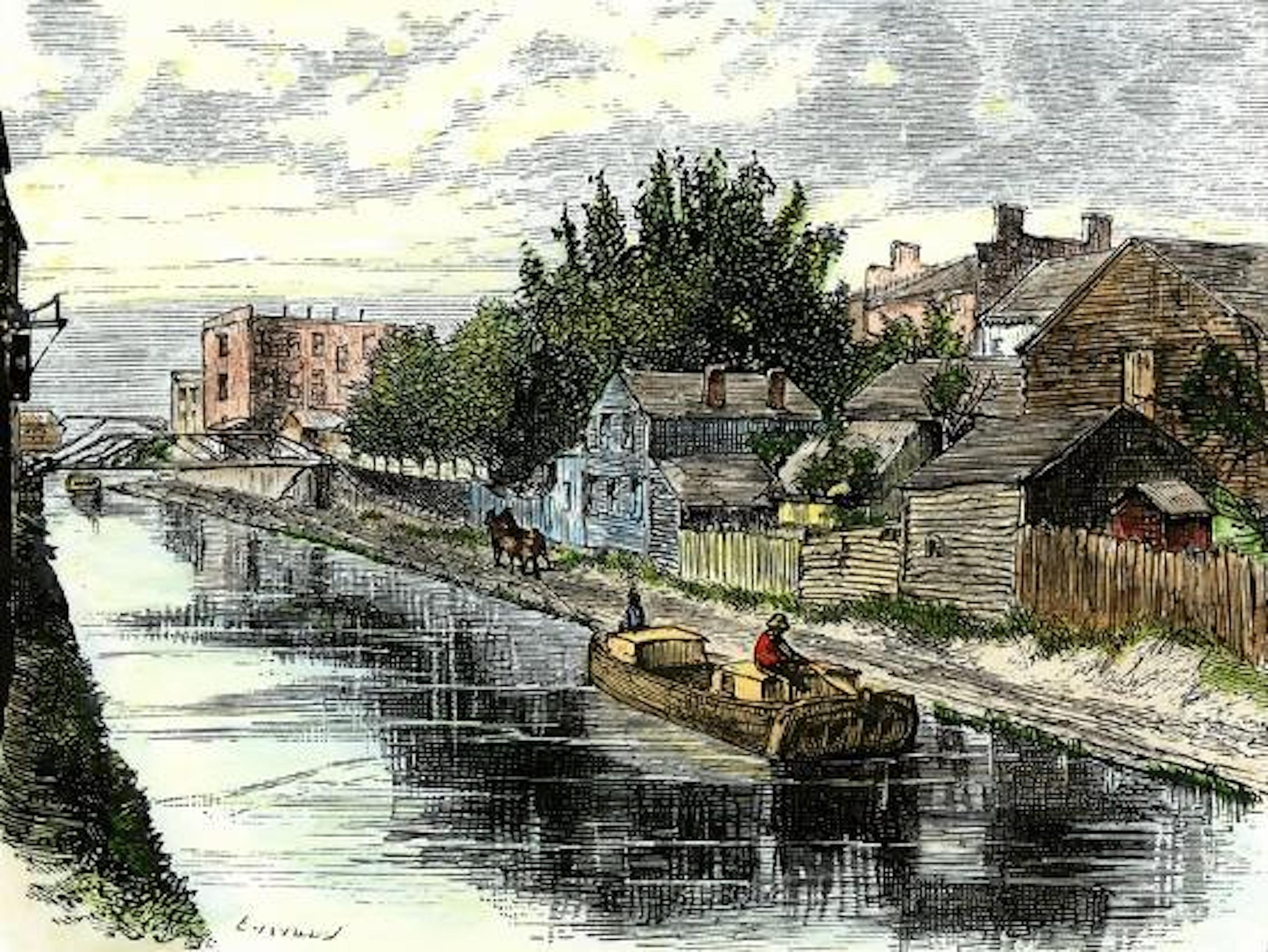 Completed in 1825, the canal was the first navigable waterway connecting the Atlantic Ocean to the Great Lakes, vastly reducing the costs of transporting people and goods across the Appalachians. The Erie Canal accelerated the settlement of the Great Lakes region, the westward expansion of the United States, and the economic ascendancy of New York state.
 -
-
In late October 1825, as Governor Clinton and his flotilla cruised from Buffalo to New York City to celebrate the opening of the Erie Canal, they met a boat carrying a strange group of 51 passengers, some “dressed in coarse cloths of domestic manufacture, of a fashion different from the American,” and others wearing “calico, gingham, and gay shawls.” History does not record whether the Father of the Erie Canal realized the strangers were the vanguard of the two million immigrants who used his “ditch” between 1825 and 1852 in search of new homes and new lives in the American Midwest.
They were the “Sloopers,” the first group of Norwegians to immigrate to the United States and the first group of immigrants to travel the completed Erie Canal.
The saga of that small band of latter-day Vikings began during the Napoleonic wars. Norway had been ruled by Denmark since 1384. So, when Denmark allied with France, the British interned Norwegian seamen as enemies, including Lars Larsen Geilane of Stavanger. He was imprisoned on his ship in the harbor at Chatham from 1807 until the war ended in 1814. While there, he and some of his shipmates were befriended by English Quakers and became converts. Upon returning home after the war, they founded near Stavanger Norway’s first and—still today—only Quaker meeting.
At that time, Norway’s government conferred on the established church a virtual monopoly of religious practice. The 1814 constitution included this clause: "The Evangelical-Lutheran religion remains the public religion of the State. Those inhabitants, who confess thereto, are bound to raise their children to the same.” Also, Jesuits, religious orders, and Jews were excluded from the national territory.
In practice, however, the government went beyond the constitutional text in suppressing dissenters. It imprisoned Hans Nielsen Hauge, a pastor who challenged the rigidities of the church hierarchy. It forbade public worship by other denominations and required that all baptisms and burials be performed according to Lutheran rites. Babies were re-baptized and bodies re-buried if that rule was violated. For instance, one of the Stavanger Quakers was fined $5 a day until he re-buried twin infants that he had interred in unconsecrated ground.
Attempts to change the oppressive laws and practices were unavailing and the Stavanger Quakers sought other relief. To think of America as a refuge was quite novel for Norwegians. They had almost no knowledge of that strange and distant land. Ninety percent of them lived on tiny farms in isolated valleys or along fjords with very little contact with the outside world. Most of their little settlements were not even connected by roads. As late as 1836, one Norwegian, upon visiting Stavanger from the countryside, wrote “We heard much talk about a country which was called America. This was the first time we had heard this word.”
The Stavanger Quakers may have learned of American religious freedom from Stephan Grellet, a French Quaker, residing in England, who had also lived in America and who befriended and supported Larsen during his imprisonment. Also, A German emigrant ship in distress had taken refuge in the harbor at Bergen, causing quite a stir. Its passengers were religious refugees who spread the word of America as a religious sanctuary.
Whatever the source of their inspiration, the Stavanger Quakers resolved to leave for America. They sent two of their followers, Kleng Pedersen Hesthammer (later known as Cleng Peerson) and Knud Olsen Eide, to the United States to scout out immigration possibilities. As most of the Sloopers were farmers, this meant finding suitable, inexpensive farmland.
The two men arrived in New York in August 1821, but were soon plagued by misfortune. Somehow, they lost the money that was supposed to finance their search, which required that they remain in New York to work and earn back the money. Then, Eide fell ill and returned to Norway. Cleng was befriended by New York Quakers. They sent him to vacant lands in western New York, where one of their number, Joseph Fellows, was land agent.
Peerson returned to Norway early in 1824 and reported favorably on their prospects in the New World. The Quakers and their sympathizers were persuaded. They sent Peerson back to America in the fall of 1824, accompanied by Andreas Stangeland, with instructions to purchase land. They set the precedent followed by the later waves of Norwegian immigrants until after the American Civil War of settling on land unbroken by the plow. Peerson arranged to buy six 40-acre parcels of land on the shore of Lake Ontario in the Town of Murray (now Kendall) in Orleans County, for $5 an acre. In fact, when the Sloopers arrived the following year, they could manage to finance only 24 acres apiece.
Meanwhile, back in Norway, Lars Larsen spearheaded preparations for the journey. Of course, no passenger liners plied the North Atlantic. So, the Quakers set about to acquire a boat suitable to their purpose. After some difficulty, Larsen and a sloop captain named Johannes Jakobsen Steine, found and purchased for 3,600 rixdollars—the equivalent of USD $3,600—a 24-year-old, 38-ton sloop, named the “Restauration” that had been used for hauling herring and grain. They engaged a skipper and first mate to bring it to Stavanger, arriving there on May 9, 1825. This was the signal for the prospective travelers to dispose of all of their homes and farms and other worldy goods, except the few they could cram into the 25 cubic foot chest each of them was allowed to bring.
Larsen, a carpenter by trade, undertook to convert the Restauration for use as a trans-Atlantic passenger vessel. To design the use of the space on that tiny vessel to accommodate 51 passengers and crew required great ingenuity. Bunks for sleeping must have been four or five deep. The 480 square feet of deck space allowed only about 9 square feet per person—plus all the personal belongings had to be stowed somewhere. Also, room had to be made for their provisions, fuel for the stove, drinking water, etc., etc. Then, too, they boarded 3.5 tons of Swedish iron as ballast. -
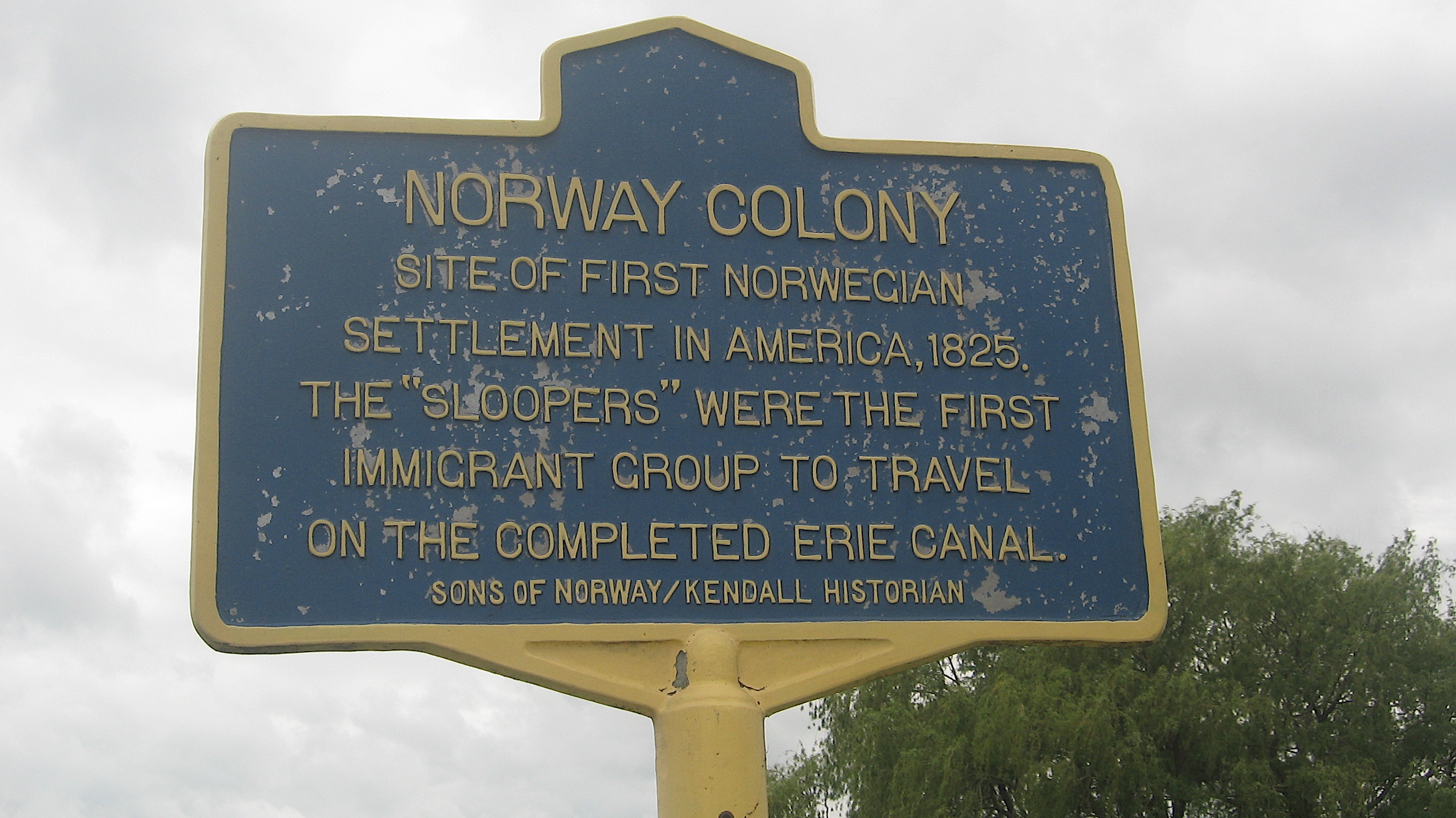 The canal, opening in October 1825 became the route of choice for the first group of Norwegians to immigrate to the United States, the so-called sloopers—quite possibly the first group of immigrants to travel the completed Erie Canal.
 -
-
Settling sail for North America
The little band set sail crossing the Atlantic on July 4, 1825. Their departure was a veritable sensation in Stavanger. It was not a regular port and no one is known to have previously emigrated from there. Some who were left behind thought the travelers were crazy and risked being kidnapped and enslaved by Turks. Three members of the original party of 53 changed their minds while still near the coast and disembarked.
Their first landfall was in Cornwall. Some Englishmen offered to trade them food for some of the brandy they had on board. They left with the brandy to get the food, but returned shortly warning the gullible Norwegians they had learned the transaction was illegal and they would be arrested unless they departed immediately—without the brandy or the food.
They landed next in the Madeira Islands, having sailed so far south to avoid the westerly winds to the north. As they approached the Funchal harbor, they spotted a barnacle-encrusted cask in the water. They hauled it onboard and discovered it carried Madeira wine. The crew and some of the passengers imbibed freely, the crew becoming so drunk that they neglected to steer the ship or hoist their colors. The Madeirans, fearing it was a plague ship or pirates, prepared to fire a cannon at them. Just in time, one of the women stood in the prow, waving her skirt. The Madeirans were reassured and wined and dined their strange visitors.
En route from there to New York, Martha Larsen gave birth to a daughter on September 2, increasing the passenger count to 51. When they arrived in New York City after a 98-day voyage, they were received with some astonishment. The New York Daily Advertiser commented that “The appearance of such a party of strangers, coming from so distant a country and in a vessel of a size apparently ill calculated for a voyage across the Atlantic, could not but excite an unusual degree of interest.”
The port authorities were certainly interested. They impounded the vessel and jailed the captain on the grounds that they had violated an 1819 act of Congress that limited the number of passengers on a ship to one person for each 2.5 tons and specified a $150 fine for each person over the limit. The 39-ton Restauration should have carried only 16 passengers! They were 35 passengers over the limit. The authorities fudged the figures a bit and charged them with only 21 violations for a fine of $3,150—an enormous sum for the impoverished travelers.
Peerson’s Quaker friends came to their rescue, persuaded the customs officials to release the captain, and successfully petitioned President John Quincy Adams for a pardon. By the time the pardon had arrived, most of the Sloopers had left for Kendall, traveling on the Erie Canal to Saltport (now Holley) and on foot the last nine miles north to Kendall on the shore of Lake Ontario.
Larsen remained behind to sell the vessel. Peerson had led him to believe it could be sold at a profit. In fact, he realized only $400 from its sale, only about one-ninth of the price they had paid. In addition, he is believed to have collected about $50 for transporting the iron, which was on consignment.
Once Larsen had completed his transactions, he set off to join his companions. When he reached Albany, he discovered the canal had closed for the winter. Therefore, he made a pair of ice skates and skated the 290 miles to Holley. That may be the longest cross-country ice skating feat in history. -
 The Sloop Clearwater sailing up the Hudson River photographed by Anthony Pepitone / Creative Commons Attribution 3.0 Unported. The Clearwater sloop is a replica of an 18th- and 19th-century Hudson River cargo vessel. A sloop is a single-masted sailboat with a two-sail fore-and-aft rig, consisting of a mainsail and a headsail (like a jib). This design makes it one of the most common and simplest sailboat rigs, known for being fast and relatively easy to handle, and it comes in many sizes from small dinghies to large yachts. (The original Dutch term actually applied to an open rowing boat.)
 -
Homesteading in the Land of Plenty
The Sloopers arrived in Kendall on the cold shore of Lake Ontario at the beginning of November with winter hard upon them. They had little time and less money to prepare for the harsh weather ahead. That part of New York state averages 100 inches (250 centimeters) of snow per season and the south shore of Lake Ontario exceeds that average because it bears the brunt of “lake effect” snow.
Twenty-four adults worked together to build a log cabin 12 feet square with a loft to shelter themselves and 16 children through the first winter: that's 3.6 square feet per person plus the loft. This task was complicated by the fact that upon disembarking in New York, Jacob Slogvik’s chest with most of their tools fell into the harbor and could not be retrieved.
The land on which they settled was known locally as “the Black North” because it was so heavily timbered that “the sun never reached the earth.” So, they had great difficulty clearing enough ground to raise enough crops to eke out a living. Other misfortunes beset them. During their first year, three of their number died and a newly-built house burned, though without further loss of life.
After struggling for eight years, in 1833 the little colony sent Cleng Peerson to scout out more hospitable land in the Midwest. He walked some 2,000 miles throughout the central states in search of a more suitable site for the settlement. He found his promised land in the Fox River Valley, about 70 miles southwest of Chicago. Was it by plan or coincidence that it was part of a land grant being sold by the agent who had sold them their property in Kendall, Quaker Joseph Fellows?
Peerson returned to Kendall in 1834 and persuaded five other families to join him in an exodus to the west. Five more families followed in May 1835 and two others came shortly after. Only one family remained permanently in Kendall.
Thus ended the saga of the Sloopers, but that little band of Norwegians searching for religious freedom left a very large mark on American history. Their voyage had initiated the greatest mass migration in human history. The Sloopers were the first group of immigrants to come directly from Europe and settle beyond the eastern seaboard. -
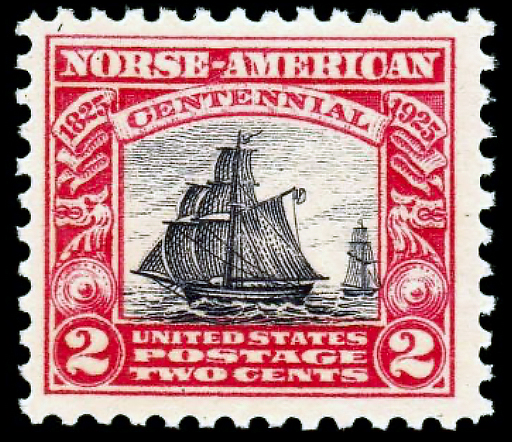 The central design shows the ship Restauration as it’s supposed to have looked in 1825. The artist used a painting of its sister ship as a model as no art existed of the Restauration.
 -
(The United States east of the Appalachians had been settled by 1825 by waves of immigrants, mainly from the British Isles and Germany. An estimated two million had immigrated in that period. Some of them or their descendants had moved on into parts of the Midwest by 1825. The 1820 census showed 1,001,000 inhabitants in the states of the Midwest (not including Louisiana). However, groups of immigrants from Europe do not seem to have come directly to the Midwest. In my canvass of studies of immigration I found no reference to groups of Europeans immigrating to the United States beyond the eastern seaboard before the Sloopers. The next group I found was some Swedes who settled near the Sloopers in Illinois in 1841. They seem to have known of the Sloopers and followed their example. They were followed by groups of immigrants from Germany and Ireland later in the 1840s and from southern and eastern Europe after the Civil War. Beginning with the Sloopers, an estimated 8,883,839 immigrants came from Europe to the United States by 1900, most of them settling in the Midwest or beyond. By the 1900 census, the states of the Midwest (again excluding Louisiana) had a population of 32,212,579. Those 18 Sloopers, pioneering travel on the Erie Canal as an immigration route, had set off the greatest, most successful human migration in history!)
-
 Brilliant pink and orange skies over the exposed pylons of the Erie Canal. The Erie Canal is periodically drained for winter maintenance and repairs, though it is never completely dry as some sections are connected to rivers and lakes. Sections of the canal are drained every fall after the navigation season ends in late November or early December and remain empty until they are refilled for the next season in April or May.
 -
Excerpt from "The Norwegian Pioneer Canal Travelers" by William G. Andrews, PhD, professor emeritus of political science, State University of New York, College at Brockport
-
Nils R. Caspersson
-
-