
Lumberman of the West
Born in Östergötland Charles Axel Smith arrived in Minneapolis with his family in 1867. By 1892, his lumber company included over 400,000 acres of timberland in Washington, Oregon and California, as well as sawmills, railroads and fabrication plants.
-
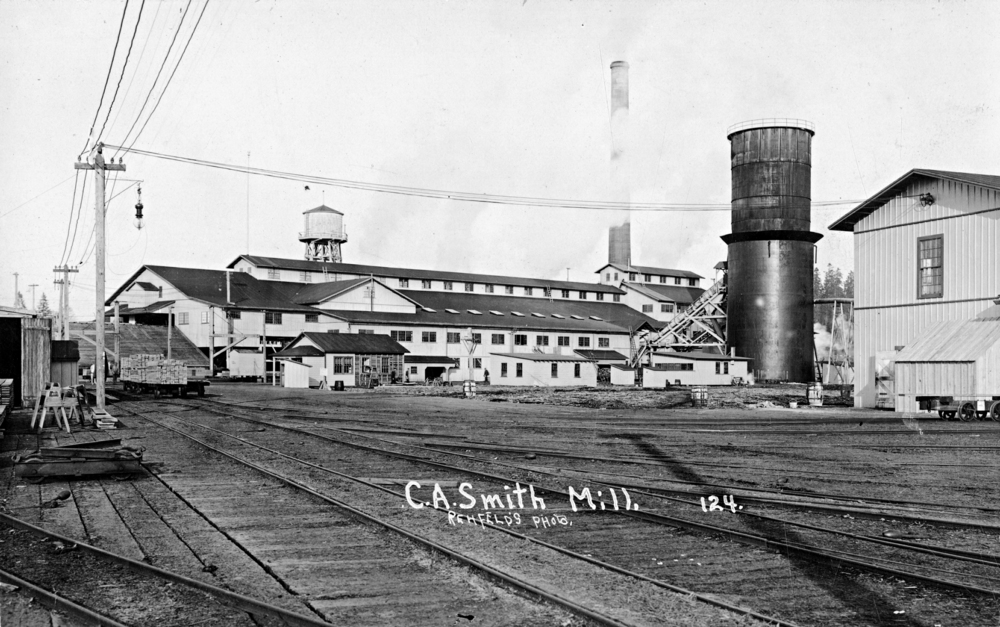 For a time, Charles Axel Smith was one of the richest lumbermen in the country.
 -
-
Charles Axel Smith was born in Östergötland, Sweden in 1852 and arrived in Minneapolis with his family in 1867. He changed his name from Willd to Smith when attending high school and later attended university.
Smith became a partner with Pillsbury to build a grain elevator but eventually changed his business interest from grain to lumber. By 1892, his lumber company included over 400,000 acres of timberland in Washington, Oregon and California, as well as sawmills, railroads and fabrication plants.
Smith was a savvy entrepreneur, as cited in the Oregon History Project: “Capital, Transportation, and Technology Transform the Economy: The Coastal Lumber Industry.” He made several secret trips from Minneapolis to the West Coast searching for timber. To keep competitors from learning his intentions, he traveled incognito and relied on anonymous agents who scouted the country for the richest stands. In this way he acquired thousands of acres of virgin Douglas fir and redwood, some of it (in company with his other capitalists) by both legal and illegal means. He also purchased 30 thousand acres of timberlands from E.B. Dean and Co., along with their logging railroads and Marshfield mill facilities.
In 1907 Smith built a state-of-the-art sawmill on the tide flats of the upper bay in Coos, Oregon. He brought in an army of transplanted Scandinavians — Swedish and Finnish millwrights, machinists, blacksmiths, mechanics, sawyers, edgers, trimmers, planers, greenchain pullers, and water boys — to build and operate his Big Mill, as it came to be called. With his Oregon partner Albert Powers, he operated seven logging camps along the wooded tributaries to Coos Bay. By 1920, about half the loggers and sawmill workers on Coos Bay worked for Smith.
Smith took pride in pioneering the most efficient milling technology and the most enlightened forestry practices of the day. He and Powers brought in trained foresters to start a reforestation program. They invited Carl Alvin Schenk, the German-born director of the Biltmore School of Forestry and a leader in scientific forest management, to bring his students on field trips to learn from Smith’s operations. -
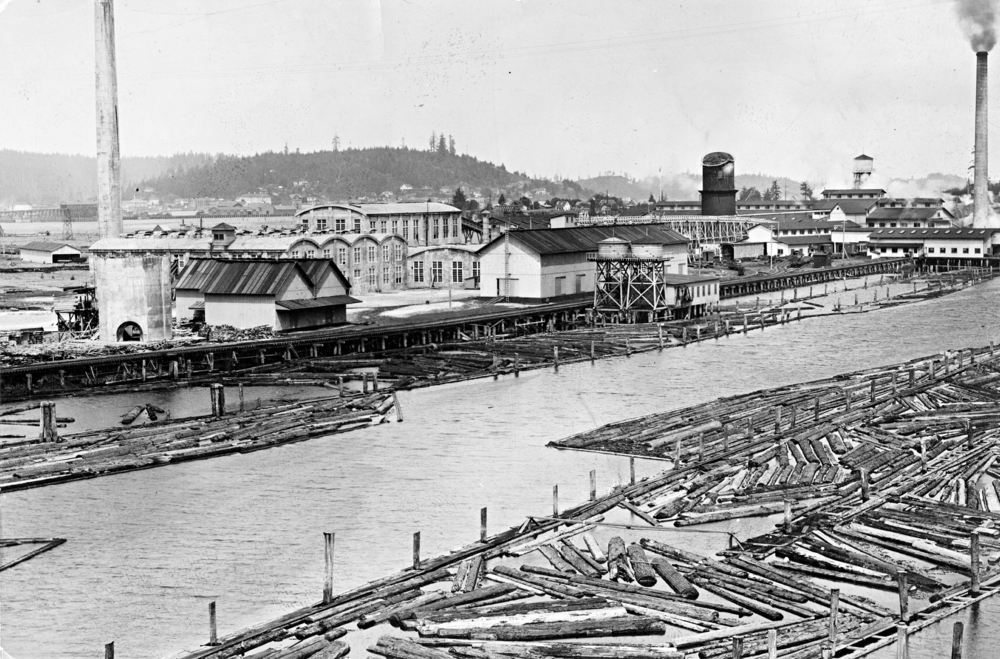 By 1892, his lumber company included over 400,000 acres of timberland in Washington, Oregon and California, as well as sawmills, railroads and fabrication plants.
 -
-
Intsrumental in the transformation the timber economy
Smith was one of several turn-of-the century entrepreneurs who came from somewhere else to transform the timber economy of the West Coast into a highly capitalized, technology heavy, big business. Smith’s operation was a vast network of miles of logging railroads, several logging camps, booming and rafting facilities, waterfront docks for loading lumber, and company ships to transport rough-cut lumber to the company's finishing facilities at Bay Point, California.
Smith’s Big Mill dominated lumber production on Coos Bay for almost 50 years, and although he never lived there permanently, C.A. Smith left an indelible stamp on Coos Bay’s landscape and communities. Today not a few of North Coast Swedish Americans can trace their family origins to the early lumbermen employed by Smith.
Smith served as Swedish Consul in Minneapolis before the family moved to Oakland in 1914. He would have been 62 at the time and may have been retired. On the other hand, he advertised in the Alameda County Scandinavians Directory of 1900, indicating he had business interests here prior to his retirement.
Oakland was a major producer of goods and a shipping and rail hub for raw and manufactured goods. West Oakland, because of the ferry service and later the site of the terminus for the cross-country rail service, attracted a large immigrant workforce. Many industrialists moved there by the 1920s, living close to this transportation infrastructure and resources. As early as the 1860s there were sawmills in West Oakland, and Smith was involved in various lumbering activities from Oakland to Bay Point.
According to the local Oakland Wiki, Smith can be traced to The Security Bank and Trust of Oakland in the early 1900s. In 1918 the bank was absorbed by the Bank of Italy, which became Bank of America. It was later known as the Key System building. In 1904, Smith was the cashier. He was in the company of other rich and influential men, including H.C. Capwell, the bank founder and one of the directors, who owned Capwell’s Department store downtown. In 1911 Smith was still the cashier; by 1912, there were two assistant cashiers. -
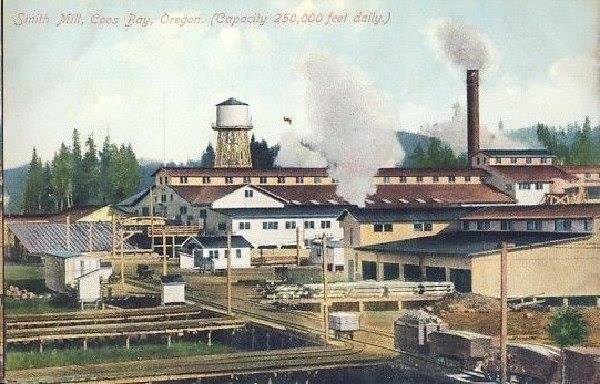 The Smith mill in Coos Bay, Oregon
 -
From riches to rags
Like some other entrepreneurs, Smith overextended himself and eventually lost his wealth. But for a time, he was one of the richest lumbermen in the country. His home still stands in Berkeley, with a full view of the nearby Claremont Hotel, where another Swedish American, Erik Lindblom, who made his fortune in gold mining, also lost his fortune. The two were contemporaries and most likely knew or knew of each other. Both made their fortunes through resource extraction, in this case depleting lumber and gold, with not much thought for the future impact on the environment. (See Vol. 139, No. 12, June 30, 2011 issue of Nordstjernan for more on Lindblom, “The Lucky Swede.”)
We should nevertheless celebrate them as outstanding examples of the Swedish entrepreneurs at the turn of the last century, men who were willing to take big risks, and whose fortunes rose and fell with the times.
Kitty Hughes -
-